
Robert Amacker
There are a variety of theories concerning the use of kicks in martial arts. All of the methods have their proper use, and their own particular drawbacks, and all are undoubtedly effective in certain situations. My own concern is not with the most powerful, fastest, or deadliest kick, but with a theory of kicking that conforms completely to the most sophisticated techniques of Taijiquan. Such kicks would integrate effortlessly with the normal movements of neutralization associated with Taijiquan and indeed grow out of them naturally.
I should begin with the caveat that all kicking is, as a fighting technique, is highly dangerous against any sort of skilled fighter; and the rewards in terms of power, from any internal point of view, are negligible.
Kicks to the knee and below fall into another category, as they do not require the assumption of a highly vulnerable position by the person executing them. I tell my students that the two great mistakes are (1) trying to kick someone in the shins on purpose, and (2) avoiding kicking them when they get in the way of one’s step.
The fact is, there are no martial techniques which are not appropriate under some circumstances, and there are certain conditions in which the actions of the opponent produce, as the proper response, kicks. The same can be said for steps, which are, as I have suggested, intimately connected with kicks.
In explaining the proper technique I will address the question of power first, as other points will become more obvious. We must first pose the question: from which leg does the kicking power come from, the kicking leg, the standing leg, or both? If the kick is to have any jin, it is essential that the muscles of the kicking leg be only used for shaping the leg so that it transfers the maximum amount of energy from the action of the hip, and timing the release of the foreleg. Any attempt to add power to the kick will interfere with the timing of the wave action rising from the root. Imagine if a whip had a small motor in the end of it that attempted to make the strike faster and more powerful by adding a little extra force. Its actual effect would be to simply kill the wave emanating from the handle.
For the power of the kick we must look to the kua of the standing leg. It is here that the wave begins, which, after reflecting off of the root, powers the action of the kicking leg (fig. 1).
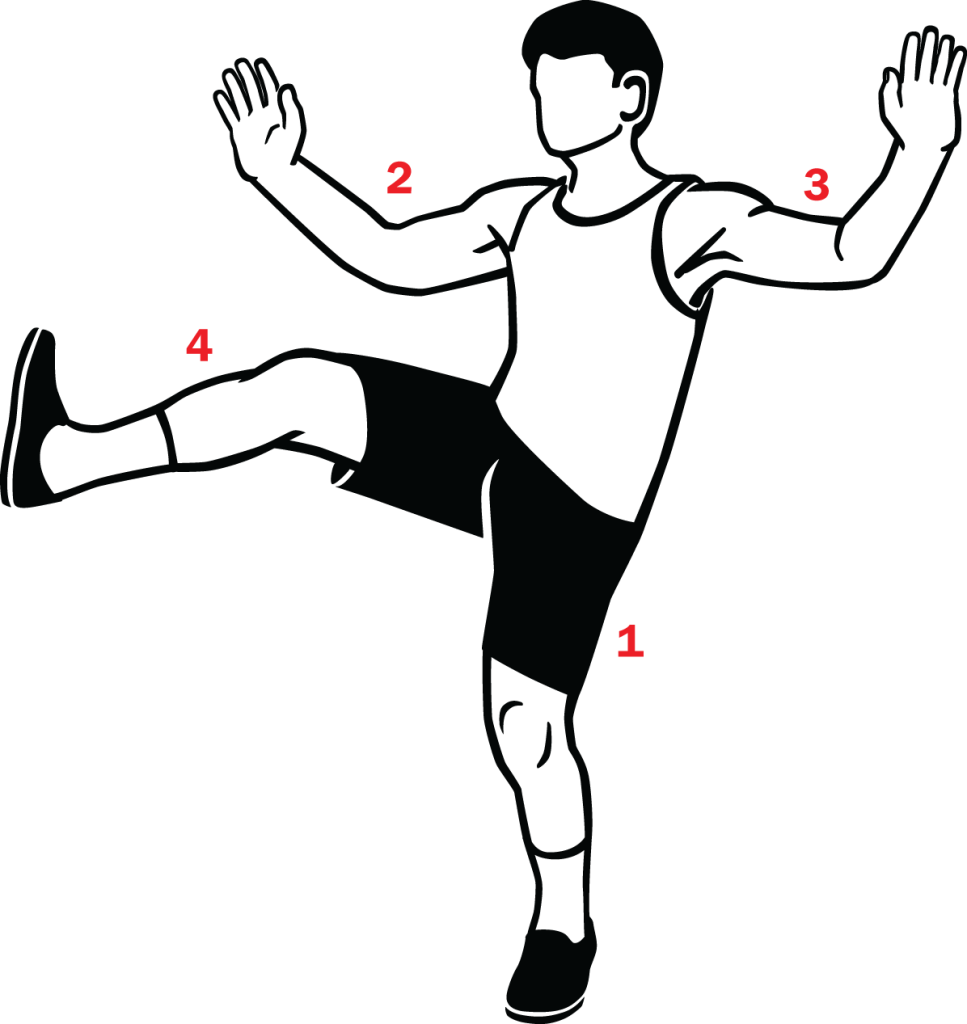
Fig. 1. The differentiation of substantial and insubstantial causes movement to be propagated through the body in the form of a wave function. This dictates a sequential activity in the limbs, a sequence that it is possible to consciously control. Ideal balance and power are achieved when this sequence is in the order indicated here. The origin of power is the kua, wich uses the largest muscle group in the body, causing the dantian and leg to be pulled towards or pushed away from each other. The proper amount of friction on the floor results in the immobility of the foot, which then becomes the “root” of the body’s movement. This can be thought of as a wave originating in the kua and reflecting from the foot. The next place to be struck by the wave is the arm on the opposite side of the body as the kua employed, followed by the arm on the same side of the body, followed finally by the opposite leg. The faster the wave moves, the more action of each limb is expressed before that of the successive limb begins. This is called the separation of substantial and insubstantial. At high speed, the size of the movement is smaller and the individual movement of the limbs is more discrete, but at the speed of the solo form, the movements are almost simultaneous.
It should be noted that this is not the highest sophistication of jin. In this example there is a deliberate action of the leg muscles, winding first in one direction and then in the opposite. The speed of this change determines the power of the kick, by translating directly into the frequency of the wave transmitted to the kicking leg. This frequency is inversely proportional to the size of the wave, so the smaller (and hence more “invisible”) the movement, the greater the power of the kick. Always keep in mind, however, that a description of the ultimate form of any “internal” movement is not a model for efficient practice. All internal techniques must be developed according to the basic principle of Qigong, which is: first practice the movement in its largest form at a slow speed, and gradually reduce its size while simultaneously increasing its speed. This should never be done in the context of the Solo Form, which should always be done in a large frame and at slow speed, but is produced by greater aggressiveness on the part of the partner or opponent. Extending this process to its practical limit is definitive of what is referred to as “broken” jin. It is associated with extreme softness, because the softer the object, the higher frequency wave it will transmit. But no amount of deliberate action will produce a jin that is as “broken” as that generated by sudden and unexpected resistance from the opponent. If the practitioner is soft enough, this break in his neutralization process will generate the highest possible frequency wave, resulting in a very small movement of the hand, but at a terrific speed. This is completely contrary to the logic of “external” boxing, in which power is exerted over the largest possible distance to generate the greatest possible speed at the end. Given the choice, the average boxer will consistently take the largest possible “windup” movement. On the other hand, Yang Chengfu dictated that power never be expressed over a distance greater than one inch.
Actually, it is impossible for kicks to conform to this standard. Because they are unable to transmit chansijin to the point of contact (the winding muscles cannot be efficiently or usefully employed in the kicking leg), they are more comparable to a nunchaku or three section staff. They must either thrust or swing in an arc, transmitting the power of the wave but grossly diminishing the speed at impact by dissipating it through a greater distance. In many Asian traditions, the term “whip” is applied to any jointed object, and the kicking leg meets at least that standard. But one end of the internal “whip,” corresponding to the handle, is actually the hip joint of the standing leg, the greatly abbreviated motion of which can generate the power to send the kick out at lightning speed.
It should be clear from the foregoing that, in the logic of external boxing, kicks are the more powerful technique (legs are stronger than arms, it’s that simple), while in that of internal systems, hand techniques reign supreme. Given the methods that they employ, both analyses are correct. But weaker though they theoretically might be, kicks have their place in internal systems. They can even demonstrate “receiving jin,” which was mentioned before as generating the most possible “brokenness.” This can only occur when there is a grab connected with it, called in Taijiquan by the posture of “pull.” The clearest example of this is practiced in the Solo Form as Separate Foot. In the application of this form, a sudden jerk of the opponent to the pulling hand generates the wave that ultimately (but very quickly) manifests as a kick.
Let us turn now to the mechanical details of the kick itself, starting with the kua. The kua is the joint between the leg and the hips. All movement in Taijiquan originates in the waist, but the waist does not simply turn by itself through some magical intervention. Its action is (or should be) entirely controlled and powered by the opening and closing of the kua. Considerable years must be invested in the practice of using only one kua at a time to control the waist, while the other, though active, simply follows.
If the joint in question (the kua) were also the center of movement for the torso, Taijiquan would be far simpler. However, the desired center of movement (the dantian) is displaced by inches from the center of power, so the entire body must adjust in compensation if the center is to remain stable. This requires intricate, internal, and complex action to accomplish. For example, if the kua is opening, such action alone would move the center in an arc backwards, unless compensated for with a flexion of the ankle, drawing the knee and hip forward simultaneously (fig. 2).
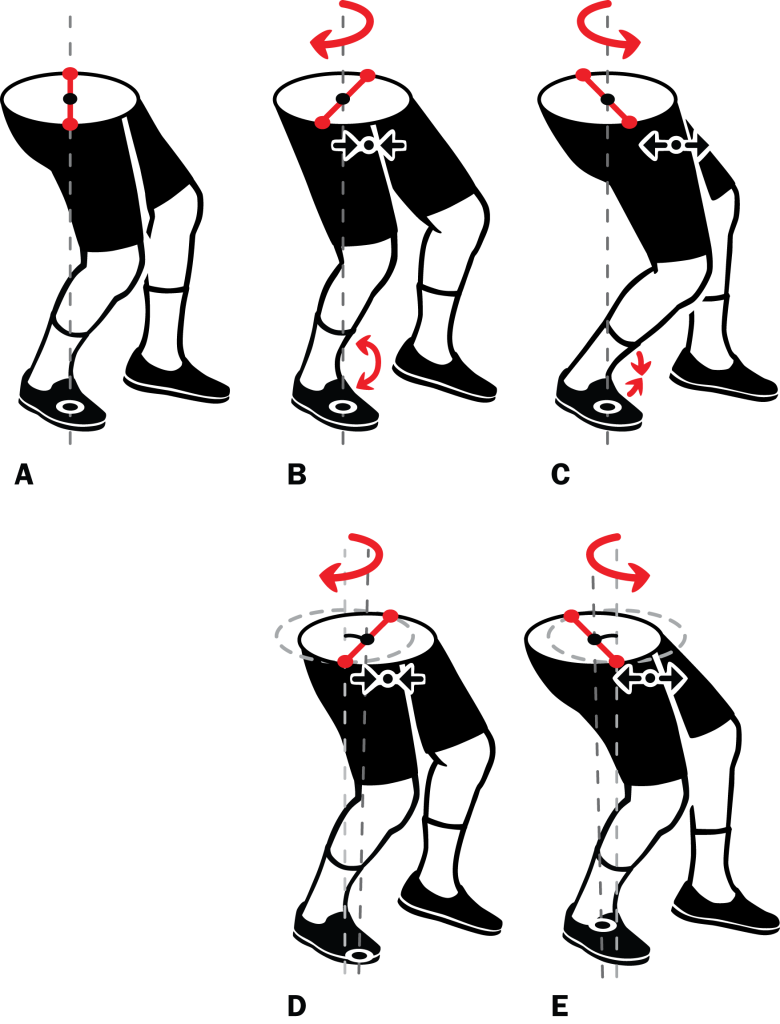
Fig. 2. Ankle adjustments needed to stabilize the center when turning the waist. A shows no kua activity, B shows the kua closing, and C shows the kua opening, together with the necessary ankle movement required. D and E show the displacement of the center caused by neglecting this complimentary adjustment, and the further result, a shifting of the weight from its proper position over the bubbling well to either over the toes (D) or back on one’s heels (E).
We should look in particular at the force exerted upon the knee by the horizontal opening or closing of the kua. First it should be observed that the lower one’s position, the more action is observable in the kua. When standing high on one’s legs, completely opening and closing the kua produces a small range of movement in the waist by comparison with the same opening and closing when done in a low stance. The lower one stands, the more the upper leg approaches the horizontal level (a level which, by the way, should never be completely reached), and the more clearly can be seen the dynamic of force created by the kua. Just as the force causes the waist to turn, there is equal force exerted laterally upon the knee. All the kua can really do is pull the knee and opposite hip towards one another, or push them away, like a door opening and closing. For the kua to deliver its full power to the waist, it is necessary to stabilize the action of the knee.
As it turns out, this stability of the knee is determined entirely by correct use of the ankle joints, in a practice that must be consciously undertaken to be perfected. The full range of movement possible to the foot in relation to the knee should be exercised, while trying to keep pronation and supination (the “rolling” of the foot along its long axis) at a minimum. Then, if one has a good root afforded by keeping the feet very flat on the ground, one can use the action of the ankle to counter the effects of the kua (fig. 3).
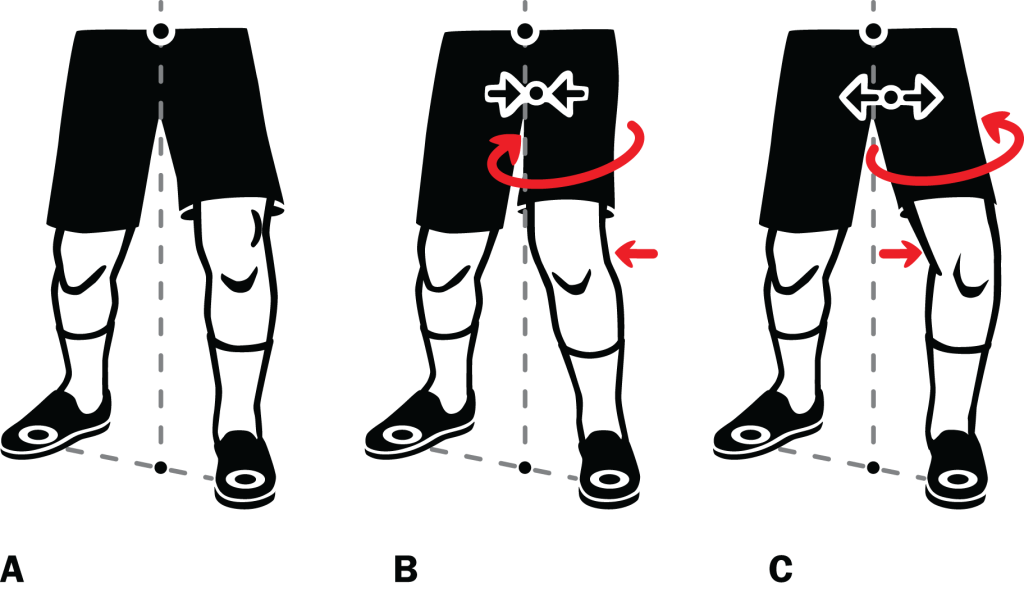
Fig. 3. Use of the ankle and foreleg rotation to stabilize the knee. A shows a stable arrow stance, viewed from the front. B shows the kua of the standing (left) leg opening and the motion of the knee being stabilized by an attempted rotation of the left foot. Because of friction preventing the foot from actually rotating, this force is reflected back as an inward pressure on the knee. When this properly balances the outward pressure being created by the opening of the kua, the knee is rendered functionally stable. D, pictured directly below, shows the result when there is no counter pressure from the ankle: the left knee is pushed outward and the weight is rolled to the side of the foot. C shows a similar stabilization to that of B, this time of the effect of the kua closing. E shows the result of neglect of foreleg rotation, similar to that shown in D, now causing the knee to cave inward. Notice that, somewhat counterintuitively, the stabilizing rotation is in the same direction as the destabilizing one, this because its reflection reverses the applied force.
That is, whenever the action of the kua would naturally pull the knee inward (making it appear to “cave” inward to someone standing directly in front), there would be a countering action coming from the ankle serving to pull the knee in the opposite direction. When the kua opened, pushing the knee out, the ankle would counter with an opposite force again, switching back and forth in its efforts exactly in concert with the opening and closing of the kua. The total effect is that, although there is considerable force acting laterally upon the knee, it would (beyond a slight vibrating) be stable. This coordination of kua and ankle activity is the kind of thing that can and should be practiced consistently while doing the formal movements.
While a very sketchy look at the internal movements of the legs, I hope that the forgoing will lay the proper foundation for this examination of the kicking process. Kicks in Taijiquan are delivered through an action (as are all Taiji techniques) of the whole body, in which the substantial parts transmit the force and control while the insubstantial parts actively follow. It has been established that proper leg technique uses the kua (in concert with the ankle and knee) to facilitate movements of the waist. We will see how those waist movements may be converted into proper kicks, but first let us look at a small model.
In correct Taiji movement, the power generated by the kua and its resultant turning of the waist is transmitted to the extremities through a wave, a wave which can only travel through a soft body. One of the stipulations for the use of such wave energy is that one must accept the finite amount of time that it takes for the original impulse to manifest in the final strike, just as there is a slight delay between the movement of the handle of a whip and the final crack at its end. Let us examine the dynamics of a flexible object and see if our technique can be made to conform to it.
If we take a whip or, for that matter, just a piece of rope, and let it hang from hip level to the ground, we can think of this as the perfectly flexible leg. After some playing around, we can determine that moving the handle end of the rope, first back, and then forward again causes the greatest snap at the proper spot. This action causes the end of the rope to flip upward and then snap backward at waist level. In our model, the only problem is that the rope continues to flip upward and smack us in the face. (Because of the limitations of the knee joint, this is not a problem in actual kicking.)
In a proper kick, then, we want no power whatsoever to be contributed by the muscles of the kicking leg, just as there is no power in the rope, except for the wave generated at one end. Luckily, there is a two-stage process available to us in learning, one which, for the first stage, does not involve the use of the kua, at least, not in terms of chansijin.
For this I tell my students to stand with their weight entirely on one leg and use the standing leg to cause their torso to tip back and forth around the dantian. It is true that for this to work properly the stu-dent must actually use the kua of the standing leg, rather than simply tipping back and forth with gravity, but he does not have to make it turn the waist. This action causes the opposite (substantial) hip to move back and forth. They now have a physical approximation of our model. The leg dangling beneath them is like the rope, and the hip moving back and forth approximates the movement of the handle of the rope. Next, the student uses the action of the hip to paw the ground in front of him, like an animal pawing the earth. This is accomplished by tipping the body forward, causing the hip to go backward (the dantian is the axis, remember). Eventually this action becomes strong enough to cause the student to literally kick himself in the buttock with the heel of his foot. This action causes the leg to fold naturally at the knee to its flexed position.
This action is like the first handle movement of a whip, backwards. Now we must generate the wave, and do it with the proper timing to cause the whip to crack. This means that just before we kick ourselves in the buttock, we reverse our action. Even though the leg has only one joint at the knee, this is enough to give it the ability to transmit the force like a wave. Just as we tipped forward, we tip suddenly backward, and the leg swings out in front, unfolding like a whip (fig. 4). This action of tipping, first towards the opponent, and then away, facilitates this wave-like action in any sort of kick, front, side, or even back kick. In a side kick, for instance, tipping towards the opponent (not, I say carefully, leaning towards the oppo-nent), pulls the kicking leg towards the body, causing it to slide up to waist level before it shoots out, a whip-like action stronger than any direct thrust. this action involves the torso as a third section of the wave-transmitting segmentation that results in a kick. This changes the nunchaku metaphor into a “three-section staff” metaphor, except now the initial section is of much greater mass, as well.
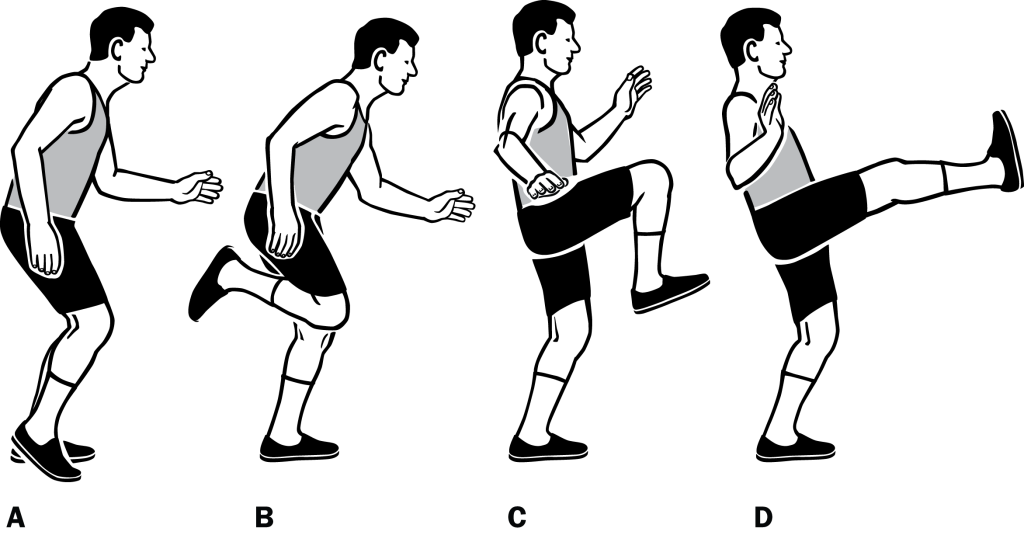
Fig. 4. Showing how the connection of hip and leg may be moved forward and back without any turning of the waist, simply by opening and closing the kua vertically, causing the torso to tip forward and backward. By timing the folding and unfolding of the knee, a relaxed and powerful kick may be accomplished with one hundred percent of the power coming from the standing leg.
If one can grasp the substance of this technique, then the next stage is relatively easy, provided a good foundation. One need simply observe that the backward and forward movement of the hip facilitating the kick can be produced in an alternative way. If one uses the kua, not to tip the body forward and back, but to simply rotate it on its vertical axis in the standard technique, the opposite hip can be clearly seen to move forward and back with each turn of the waist (provided that the center is stable). If one uses this action correctly, kicks identical to those created in the initial exercise may now be performed with the body in a completely upright position. In this case, one opens the kua of the standing leg, causing the op-posite hip to swing backwards, as was previously facilitated by tipping the body forward. As noted earlier, this chansijin action demands a careful stabilization of the knee and of the dantian, without which the power generated will be largely dissipated before it reaches the kicking foot, in a kind of physical static. Simply gross activation of chansijin without such careful stabilization will cause more harm than good. One other effect of turning the waist rather than just tipping back and forth must also be compensated for. Because the hip connection now moves in an arc instead of a straight line, both the backward and forward motion swing the leg, first laterally across the centerline in the back, and then, on the return mo-tion, in an arc across the centerline in the front. If the kick is a roundhouse type, this action may be pos-sibly desired, but if the kick is straight, this action must be controlled and made straight as well. This again addresses what I consider to be one of the fundamental challenges of Taijiquan technique, that is, the conscious manipulation of the limbs, usually found in the action of the arms, into deliberate positions, without this manipulation inhibiting the transfer of waves of force traveling back and forth through the body. This is completely doable, but requires considerable practice before it becomes unconscious be-havior. One formal side effect of the technique is that when one kicks, it is associated with rising energy, causing the player to lift rather than sink into the floor as he kicks.
In actual practice, the most elegant and natural kicking technique is achieved when one allows some slight tipping of the vertical axis, but derives at least ninety percent or more of the power from the turning of the waist. It should also be noted that in generating power, small movements, not large ones, are the rule. When moving slowly and in practice, the kua may move through considerable range in executing, for example, a kick. However, when power is desired, large slow movements are replaced by small quick ones, exactly as when using an actual whip. The movement of the kua may be so small and so quick that to an observer (especially considering the slight time delay mentioned earlier) its connection with the ac-tual kick may be lost, and the kick may appear to derive its power solely from the kicking leg. The gener-ated power will, however, be tremendously enhanced.
This connection of the kick with the turning of the waist joins it inseparably with the neutralization process. It means that every turn of the waist and, in particular, every quick reversal of the waist generates at least the basic requirements for a proper kick. However, it locks those potential kicks forever into the timing dictated by the action of neutralization, and this timing should never be rushed or delayed. The most common problem with my students in the delivery of all of their techniques (hands or feet) is perhaps rushing the discharge of force, that is, having the proper timing and position but not being willing to wait for the force to develop naturally. It is like having a whip with a mind of its own in the tip, trying to rush out and hit the target before the wave reaches the end.
One more thing must be mentioned. For this technique to work at all, and a critical factor in just how well it works, requires the absolute integrity of the torso. The spine must be held straight and the whole torso made like an unbreakable egg. Without this integrity, the force of the waist is completely dissipated and the kick is weak. Despite this, any kick aiming higher than the knee of the opponent requires one de-liberate and properly timed break in this torso integrity, in the lower spine. The exact movement so warned against when attempting to align the lower back with the floor, referred to as “tucking under,” is now a critical element of the kick. This action is timed to occur just as the turning of the waist reverses itself, and to return to standard postural integrity immediately following the focus of the kick. In formal slow mo-tion practice the position is held for an instant as the kick develops, but at practical speed it passes by like a flickering candle (fig. 5).
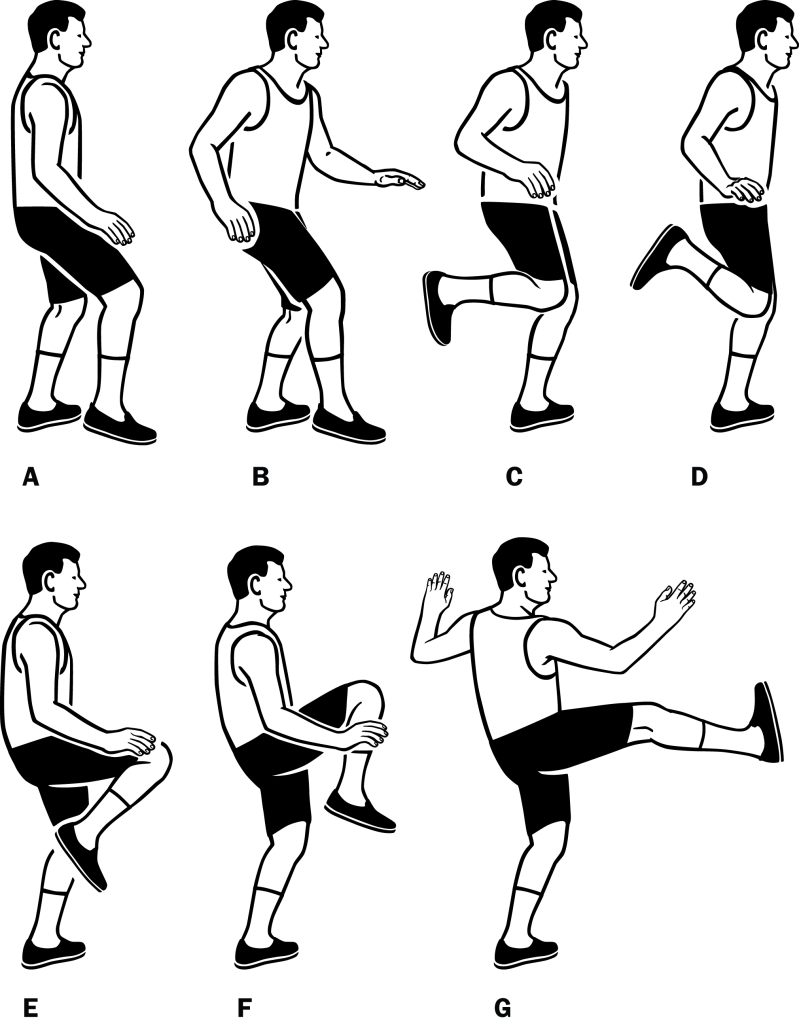
Fig. 5. The back and forth action of the hip of the insubstantial leg is now facilitated by opening and closing the kua of the opposite (standing) leg. The tipping action of the torso is reduced almost to zero and the use of chansijin allows for very short, high-speed impulses to be transmitted with a minimum of waist movement.
Kicking, like any other aggressive action in fighting, is virtually worthless without proper timing. I mentioned in the beginning that the ideal kick should grow from and therefore be perfectly coordinated with the natural mechanism for neutralization. It should be clear from the text that the proper kick does indeed utilize exactly the same turns of the waist that are associated with neutralization. This same physical co-ordination virtually guarantees that the timing of the kick will also be the most ideal possible with respect to the actions of the opponent. I have made the point many times that a mistake in the placement of the foot in stepping of less than an inch can render the associated technique practically powerless, and that any attempt to improve one’s position from that dictated by proper technique is sorely misguided. The same is true for timing. Proper technique will dictate the exact timing of one’s strike, whether it be with hands or feet, and any attempt to “improve” this in any way will be equally misguided. Relax and allow the neutralizing action of the kua to dictate the proper mobilization of steps and kicks in terms of both time and space. My teacher Chu Chufang used to put it in the form of a little rhyme:
“Never hurry, never wait;
Always hurry, always late.”
